How to measure your vertical jump at home
To measure your vertical jump at home, stand side-on to a wall, reach up and mark the highest point you can touch with your feet flat. Then jump and mark the highest point you can touch. The distance between the two marks is your vertical jump. You need a wall, something to mark with and a tape measure. You can also calculate it from hang time on a slow-motion video, or use a phone app such as Hoopium.
- The simplest method is reach and jump: mark your standing reach on a wall, jump and mark again, and measure the gap
- You can also work it out from hang time filmed in slow motion
- Hoopium's combine mode includes a vertical jump measurement, on iPhone
What is a vertical jump, exactly?
It is how high you raise your body off the ground, not how high you can reach. That is why every method compares two things: where you start and where you get to.
A standing vertical is taken from a standstill with no step. A running or max vertical allows an approach. Pick one and stick to it, because they give different numbers.
How do you do the wall reach test?
Standing reach
Stand side-on to a wall, feet flat. Reach up with the near hand and mark the highest point.
Jump
From a standstill, jump and touch the wall as high as you can. Mark it.
Measure
The gap between the two marks is your vertical.
Repeat
Take the best of three attempts.
- Chalk on your fingertips, or a piece of tape stuck to a finger, leaves a clean mark.
- Keep the same shoulder against the wall for both marks.
- Do not let your heels lift on the standing reach. That is the most common way people flatter their number.
- Land on both feet, on a surface that is not slippery.
How do you work it out from hang time?
Film the jump in slow motion and time how long your feet are off the ground. Physics does the rest: jump height equals gravity times the hang time squared, divided by eight.
| Hang time | Jump height | In inches |
|---|---|---|
| 0.40 seconds | 0.20 m | About 7.7 |
| 0.50 seconds | 0.31 m | About 12.1 |
| 0.60 seconds | 0.44 m | About 17.4 |
| 0.70 seconds | 0.60 m | About 23.7 |
| 0.80 seconds | 0.78 m | About 30.9 |
The table uses 9.81 metres per second squared for gravity. To time it, count the video frames between your toes leaving the floor and touching it again, and divide by the frame rate your phone recorded at.
One warning. This method assumes you land the way you took off. Tuck your knees or land with bent legs and your hang time grows without your jump getting any higher. Take off and land with your legs straight.
Which method should you use?
| Method | Needs | Strength | Weakness |
|---|---|---|---|
| Wall reach | A wall, chalk or tape, a tape measure | Simple and hard to fool | Needs a suitable wall |
| Hang time | A phone with slow motion | Works anywhere | Easy to inflate by tucking your legs |
| A phone app | A phone, propped up | Quick, and keeps a record | Depends on a clear camera view |
Whichever you choose, use the same one every time. Your number from the wall and your number from a video will not match exactly, and switching between them hides real progress.
How does Hoopium measure your vertical?
Hoopium is a basketball training and community app that tracks your shots with AI and connects you with players at your local court. Its combine mode has athletic tests inspired by the NBA combine, including a vertical jump measurement. You prop the phone, jump, and the app gives you your height, using the camera.
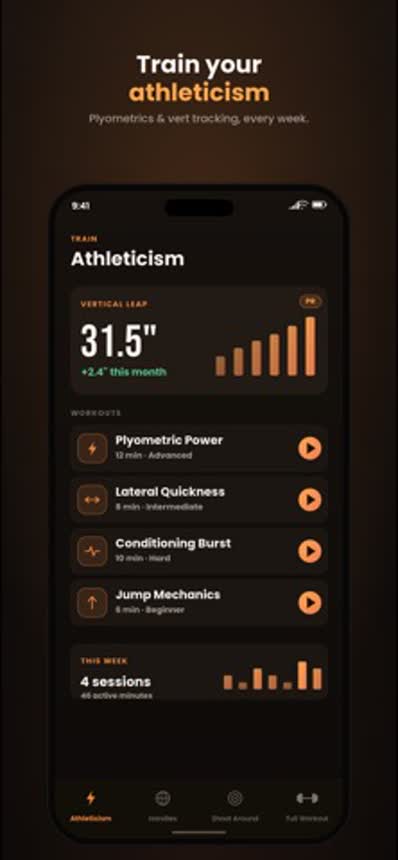
The result feeds your player card. Hoopium gives you an overall rating in the style of 2K, and testing your athleticism is one of the ways to raise it, alongside handles and shooting workouts.
How do you get an accurate reading?
- Warm up first. A cold jump is a low jump.
- Same method, same shoes, same surface each time.
- Test fresh, not at the end of a hard session.
- Take the best of three, with a short rest between.
- If you are filming, keep the whole body and the floor in frame.
- Write the number down with the date.
How often should you test?
Every few weeks is plenty. A vertical does not change in a day, and testing too often just measures how tired you are.
What moves it is training between tests: strength work, jumping practice, and rest. Hoopium includes athleticism workouts alongside the test. If you have an injury or a health condition, check with a professional before starting jump training.
What else can you track alongside it?
Your vertical is one number. For basketball it sits next to how well you shoot and how well you handle the ball. See how to track your shooting percentage, and how a shot tracking app can count for you.
Is Hoopium free?
Yes. It is free to download on the App Store, on iPhone. An optional premium tier gives you unlimited energy and removes ads.