Guides / SEO
Case study: from no website to found on Google and ChatGPT
Joe Vu mows lawns and does gardening in Sydney. Before he came to us he had a Google Business Profile and a Facebook page, but no website at all. We built him a site with online booking and made him the first client on our SEO package. He now regularly finds new customers through Google and through ChatGPT. This is how it was done. It is one business's story, told as it happened, and not a promise of what any other business will get.
- Joe mows lawns in Sydney and had a Google profile and a Facebook page, but no website
- We built a site with online booking and made him the first client on our SEO package
- He now regularly finds new customers through Google and through ChatGPT
Where did Joe start?
With what a lot of good tradespeople have: a strong reputation, a Google Business Profile with reviews from real customers, a Facebook page, and a phone that rang when someone was given his number.
What he did not have was anywhere to send a stranger. A person searching for lawn mowing in his part of Sydney could find his profile, but there was no page describing each service, no way to see his prices or his work in one place, and no way to book without ringing. Bookings were made by phone and by message.
| Before | After | |
|---|---|---|
| Website | None | A site with a page for each service |
| Bookings | Phone calls and messages | Customers pick a day and time online |
| Quotes | Drive out and look | Customers send photos of the lawn first |
| Calendar | Kept by hand | Bookings land in his phone calendar |
| Changes to the site | Not applicable | He edits words, photos and days off himself |
| Found through | Word of mouth and his Google profile | Google search, his profile, and ChatGPT |
What did we build?
A website made for one job: turning a search into a booked lawn.
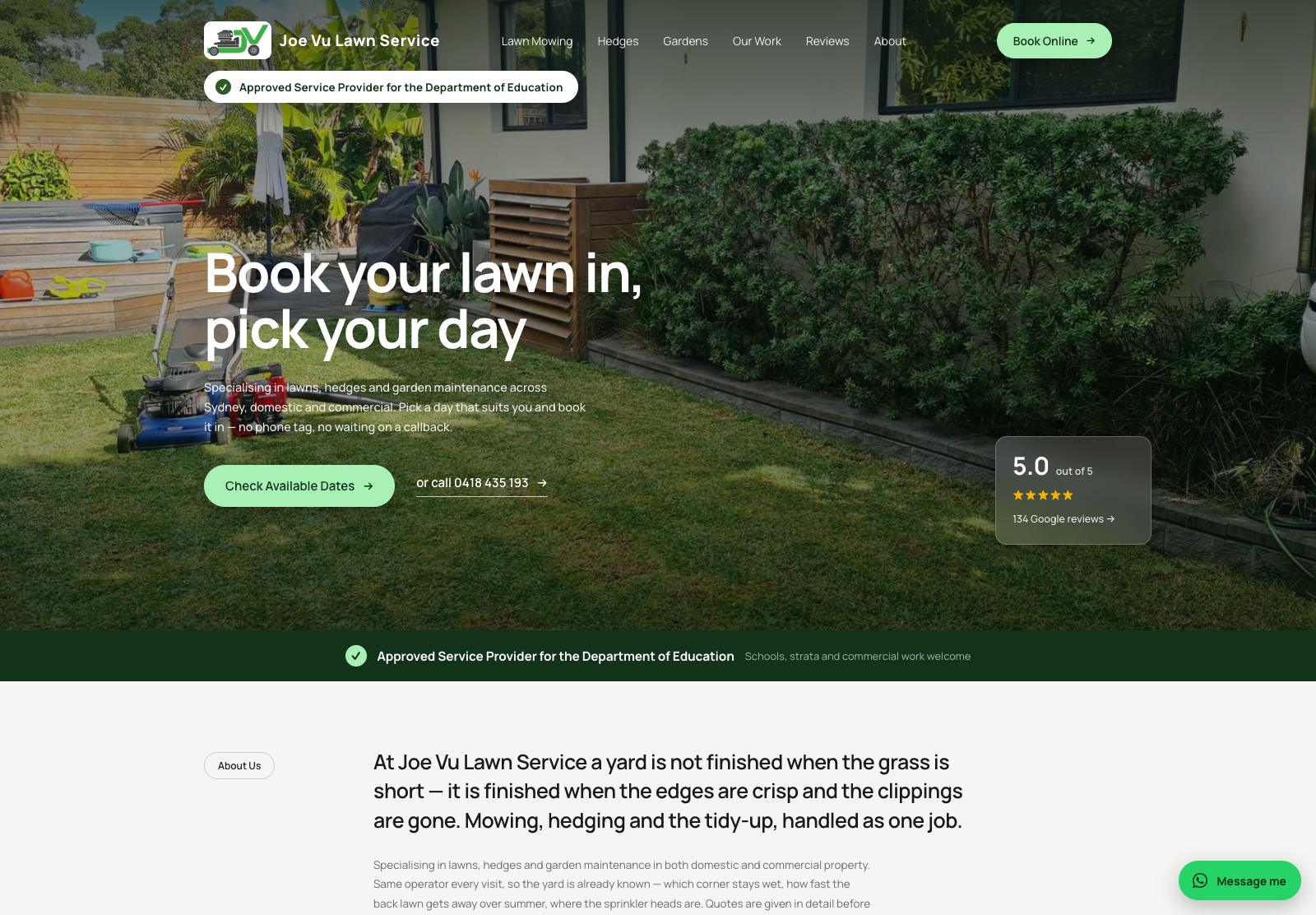
- A page for each service. Lawn mowing, hedges, garden work and the rest each have their own page, built around what people in his area search for.
- Online booking from his real availability. Customers pick a day and a time he is actually free. No phone tag.
- Photos with the booking. Customers attach photos of the lawn, so he can price the job before he drives out.
- Calendar sync. Each booking lands in the calendar on his phone.
- His Google reviews on the site, pulled from his profile.
- An owner admin. One password-protected page where he changes the wording, photos, videos and his days off, without asking us.
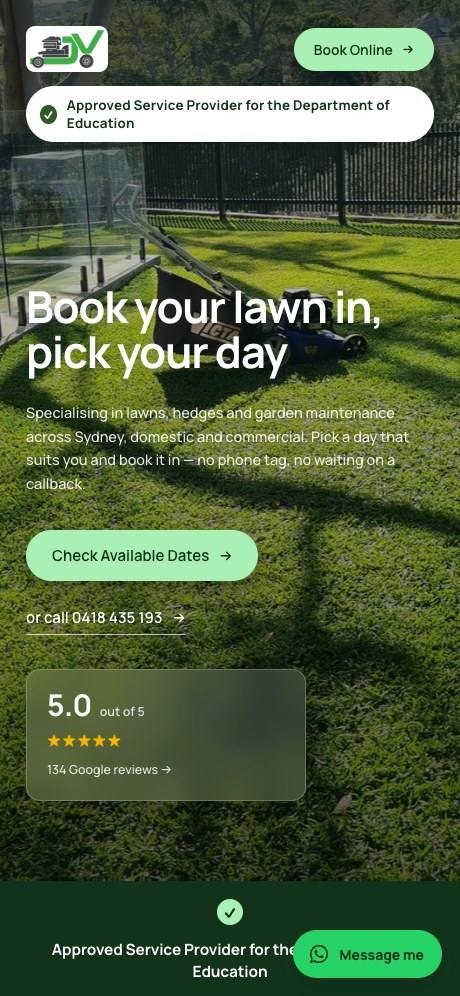
The photos are his own. Stock pictures of perfect lawns would have looked better and convinced nobody.
How was the SEO package applied?
Joe was the first client on our results-tied SEO package, so his site is where the method was worked out.
See every search
Search Console showed which searches the new site was appearing for, and where.
Choose what matters
Joe picked the services and suburbs he wanted more of.
Target them
Each chosen search got a page built to answer it, with his own photos and details.
Keep checking
We watched the same report and adjusted the pages that were not moving.
The pages follow one layout, because it worked: the service and the place in the heading, a one-line summary, a button to book, what is included, how it works, what affects the price, recent jobs, and the questions customers ask. Alongside the site, his Google Business Profile was kept in step with it, and he kept asking customers for reviews.
What happened?
The site went live in September 2026, and Joe now regularly finds new customers through Google and through ChatGPT. He knows about the second because he asks new customers how they found him.
We are not publishing figures on this page. What we can say plainly is the order things happened in: the site was found by Google, it began appearing for the searches Joe had chosen, enquiries started arriving through the booking form, and new customers began telling him an AI assistant had pointed them to him.
This is one business's experience, not a typical result and not a promise. Joe had years of good work and real reviews behind him before the site existed. The site gave that reputation somewhere to be found.
Why did ChatGPT start recommending him?
Nobody outside OpenAI can say for certain, and we will not pretend to. What we can say is what an assistant finds when it goes looking.
When ChatGPT searches the web it uses a crawler that OpenAI says "is used to surface websites in search results in ChatGPT's search features." For a question about lawn mowing in Joe's area, it now finds a site that states plainly what he does and where, pages for each service, real reviews, and a way to book. Before, there was no site to read.
That is the whole trick, and it is not a trick. Our guide on getting recommended by ChatGPT sets out what any business can do.
What would we tell a business in Joe's position?
- A Google profile and a Facebook page are a good start, but neither is yours, and neither answers a detailed search.
- Get a site live quickly. It cannot be found until it exists.
- Give every service its own page.
- Use your own photos, even if they are not perfect.
- Let people book or ask for a quote without ringing.
- Keep asking for reviews.
- Ask every new customer how they found you, and write it down.
Our guide to whether your business needs a website covers the first point in more detail.
What does this not prove?
It does not prove that a website will fill any business's diary. Joe's trade has steady local demand, and his reputation was earned over years of work. Google itself says no one can guarantee a #1 ranking, and that holds for us too.
What it does show is that a business with a good name and no website is leaving that name where few people can find it, and that fixing it does not take long.