Guides / SEO
How to get your business recommended by ChatGPT
You cannot buy a recommendation from ChatGPT, and there is no form to submit your business. When someone asks it for a lawn mowing service or an electrician nearby, ChatGPT searches the web and builds its answer from pages it can read. So the work is plain: have a real website with specific, useful pages, keep your Google Business Profile and reviews in good order, make sure OpenAI's crawler is allowed in, and be mentioned in more than one place. It is the same work that gets you found on Google, done thoroughly.
- You cannot pay or apply to be recommended: ChatGPT searches the web and names businesses it can find and verify
- Have a real website it can read, with specific pages that answer what customers ask
- Keep your Google profile, reviews and details consistent everywhere, and let OpenAI's search crawler in
How does ChatGPT decide which businesses to recommend?
OpenAI does not publish a ranking formula, and anyone who says they have it is guessing. What OpenAI does document is the mechanism. When ChatGPT searches the web, it relies on a crawler called OAI-SearchBot, which OpenAI says "is used to surface websites in search results in ChatGPT's search features." The answer you see is written from the pages that search brings back, with links to them.
Two things follow from that. A business with no website gives the assistant almost nothing to read, so it leans on directories and whatever else turns up. And a business whose website says only "quality service at great prices" gives it nothing specific to match against the question. The assistant is looking for a page that says, in words, that you do this job in this place.
When ChatGPT answers without searching, it works from what it learned in training, which favours businesses that have been written about widely for years. A small local business will not win there. The live search is where you can.
Is this different from ordinary SEO?
Less than the people selling it would like. Google is direct about its own AI results: "There are no additional requirements to appear in AI Overviews or AI Mode, nor other special optimizations necessary." Its guide to generative AI search says the best practices for SEO still apply, because those features are built on the same ranking systems.
Google also addresses the new acronyms. "AEO" and "GEO" are, in its words, still SEO. That is our experience too. What changes is where the emphasis falls: AI assistants reward pages that answer a specific question clearly, and they tend to ask several related questions behind the scenes for every one the customer types. Google calls this "query fan-out". A site with a real page for each service and each common question has more chances to be picked up.
What does ChatGPT need to find about your business?
- A website it can open and read without logging in, with your services described in plain text, not only in images.
- One page per service, each naming the service and the area you cover.
- Your business name, area, hours and contact details, written the same way everywhere they appear.
- A Google Business Profile that is complete and matches the website.
- Real reviews, recent and specific.
- Answers to the questions customers actually ask: prices or price ranges, how booking works, what is included.
- Mentions on other sites: local directories, suppliers, community pages, news.
None of this is exotic. It is what a careful customer would check before ringing you, and the assistant is doing that check on the customer's behalf.
What can you do yourself this week?
- Ask ChatGPT about yourself. Ask it the question a customer would ask, in your area, with web search on. Then ask it directly what it knows about your business. Note what it gets wrong or cannot find.
- Fix the basics on your site. Each service on its own page, with the place you work in the title and the first paragraph. Our guide to what pages a small business website needs covers the structure.
- Write down the answers you give on the phone. How much does it cost, how soon can you come, do you do my suburb. Put each one on the site, in a sentence a stranger could understand.
- Check your robots.txt file. It lives at yourdomain/robots.txt. If it blocks OAI-SearchBot, OpenAI says your site "will not be shown in ChatGPT search answers". Some site builders and security plugins block AI crawlers by default.
- Complete your Google Business Profile. See how to get your business on Google.
- Ask every happy customer for a review, and ask them to mention the job and the suburb. Our review guide has the wording.
- Ask new customers how they found you. It costs nothing and it is the only reliable measure you have.
What do we do for our clients?
We plan every site around how it will be found, and we treat AI assistants as one more reader. In practice that means the pages are hand-coded so the text is in the page itself, each service and each area has a page built for one search, structured data matches what is visibly on the page, and nothing blocks the crawlers that matter.
The part most small business sites are missing is useful content. A site with five thin pages gives Google and ChatGPT very little to find, trust and cite. So we add articles that answer real customer questions, written from what the owner actually knows. Google's guidance on generative AI search says the same thing in its own terms: a first-hand account is worth more than "a summary of existing content", and unique, useful content "will likely influence your website's presence in generative AI search in the long run more than any of the other suggestions in this guide".
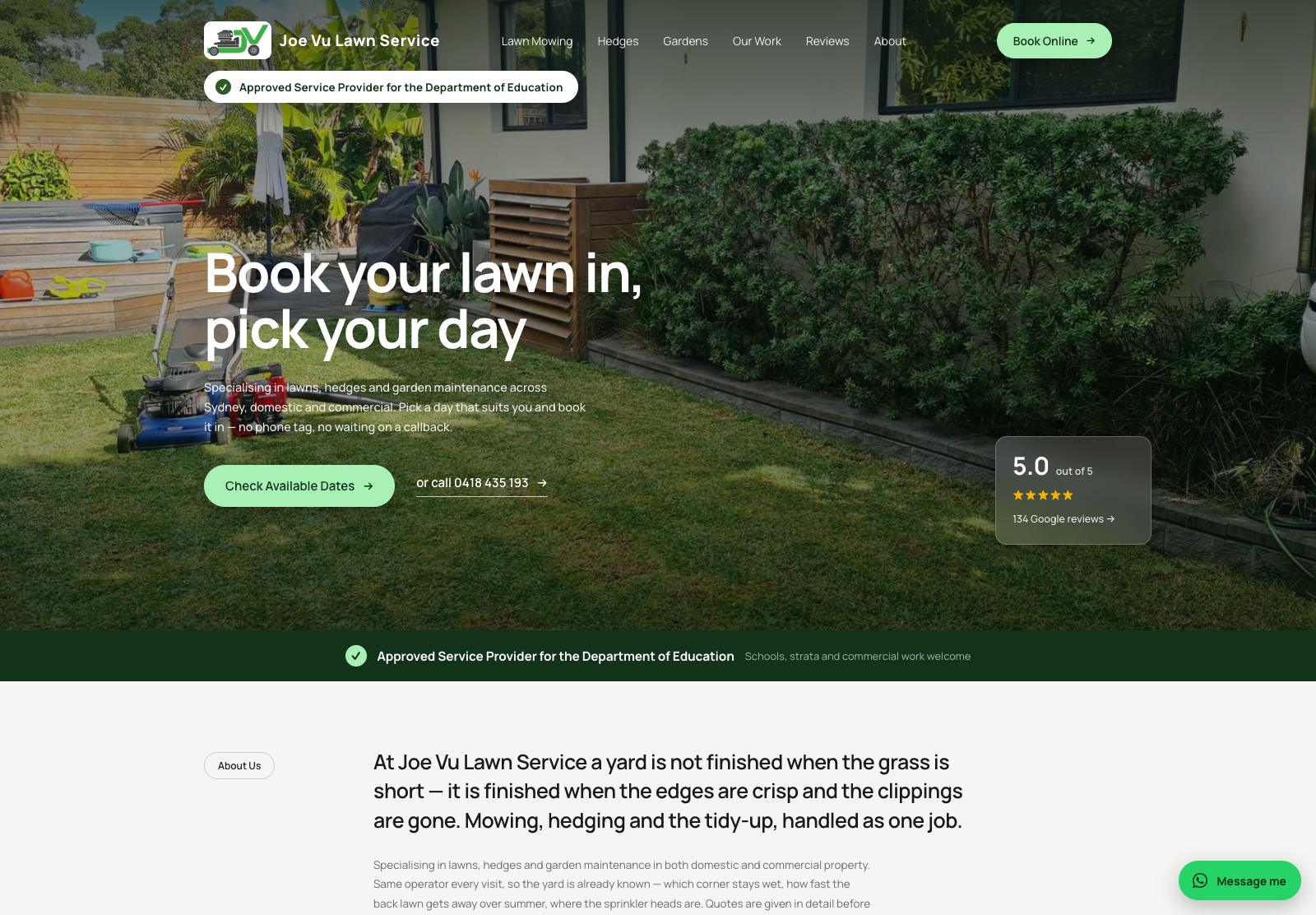
One of our clients, Joe Vu, mows lawns in Sydney. He had a Google profile and a Facebook page but no website when we started. He now regularly finds new customers through Google and through ChatGPT, which he knows because he asks them. That is one business, and his results are his own, not a forecast for anyone else. The full story is in our Joe Vu case study.
What does not work?
| Tactic | Why to skip it |
|---|---|
| Paying to be "listed on ChatGPT" | There is no such listing to buy. OpenAI documents a crawler, not a directory. |
| Hundreds of near-identical AI-written pages | Google's spam policies call this scaled content abuse, and its AI guide calls it "an ineffective long-term strategy". |
| Hidden text written for the AI | Structured data and hidden content should match what a visitor sees. Anything else is a risk for no gain. |
| A special file that guarantees inclusion | Google says you do not need "new machine readable files, AI text files, or markup" to appear in its AI features. |
| Fake reviews | Against Google's rules, and in New Zealand misleading reviews can breach the Fair Trading Act. |
On that fourth row: we do publish a short plain-text summary of our own site at /llms.txt, because it is harmless and some tools read it. We do not sell it as a ranking factor, because nobody has shown that it is one.
How do you know if it is working?
Ask customers, as Joe does. Then check the numbers you can see. Google counts clicks from its AI features inside the normal Performance report in Search Console, so growth there includes them. For ChatGPT, repeat the question you asked in step one every month or so and see whether the answer changes, remembering that answers vary from one person and one day to the next.
Be suspicious of any dashboard that claims to give you a precise "AI visibility score". The assistants do not report one.
How long does it take, and can anyone guarantee it?
Nobody can guarantee it, including us. We do not control ChatGPT or Google, and neither does any agency.
As for time, a new site first has to be found and read. Google says plainly that crawling and indexing are not guaranteed and can take a while, and its usual guidance for SEO results is months, not days. Our guide on how long SEO takes goes through it. The sooner a useful site is live, the sooner that clock starts, which is one reason we build sites in about a week.
Sources
- OpenAI: Overview of OpenAI crawlers
- Google Search Central: AI features and your website
- Google Search Central: Optimizing your website for generative AI features
- Google Search Central: Creating helpful, reliable, people-first content
- Google Search Central: Spam policies
- Google Business Profile Help: Tips to improve your local ranking on Google
- Commerce Commission: Online reviews