Guides / Web design
Website builder or web designer: which should an NZ business choose?
Use a website builder such as Wix, Squarespace or Shopify if you have more time than money, a simple site, and are happy to do the work yourself. Hire a web designer if the site needs to bring in work from Google, do something specific like take bookings, or simply be done properly without costing you your weekends. Plenty of New Zealand businesses start on a builder and move later, and that is a reasonable plan.
- Builder: cheap and quick to start, but you do all the work
- Designer: costs more, takes little of your time, and can be planned around what people search for
- Either way, register the domain in your own name
What do you get with a website builder?
A builder is software you rent. You pick a template, swap in your own words and photos, and publish. The company hosts the site and looks after security and updates, and you pay a monthly or yearly subscription.
The good parts are real. You can have a site live in a weekend, the templates look tidy, and you can change anything yourself at ten at night without waiting on anyone. Shopify in particular is a solid way to open an online store.
The limits are just as real. You are the designer, the writer and the technician. Templates are used by thousands of other sites, so yours will look a bit like them. And when you want something the builder does not offer, you either pay for an add-on app or go without.
What do you get with a web designer?
A person, or a small team, who works out what the site needs to do and then builds it. A good one asks about your customers and the work you want more of before talking about colours.
You get a design made for your business, pages structured around what people search for, help with the words, and someone to call when something needs changing. You give up some immediacy: changes go through the designer unless they build you a way to edit things yourself, and the quality depends entirely on who you hire.
Be aware that plenty of people calling themselves web designers build on the same builders and templates you could use yourself. That is not wrong, but you should know what you are paying for. Ask.
Why did we stop using a website builder ourselves?
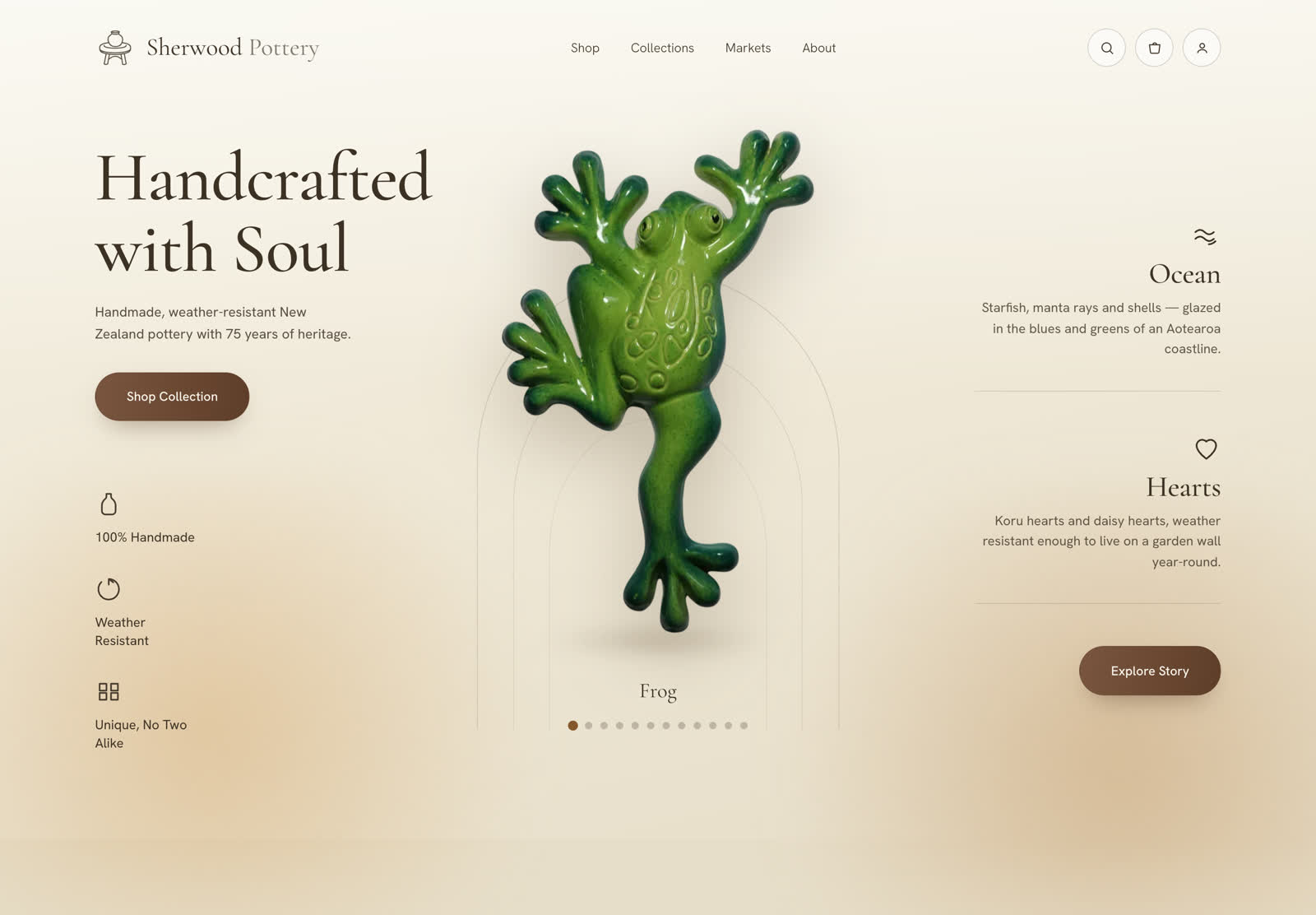
Ethelium Design started with a family project. Ethan, who runs the studio, built the first website for his grandparents' business, Sherwood Pottery, on a popular website builder called 10Web. It worked. It also came with steep monthly fees, and he kept running into the limits of its interface: fixed design elements, set widgets, and little room to build anything the builder had not planned for.
So he taught himself to code in HTML and rebuilt the site from scratch. No monthly builder subscription, and no restrictions on how it could look or work. That rebuilt store is the one pictured above, and it is why every site we make is hand-coded.
The same limits apply to most website builders, whether it is Wix, Shopify or Squarespace. They are designed to suit everyone, which means they rarely fit any one business perfectly.
What can a website builder not do?
Most everyday things, a builder does well. Where it stops is anything it was not designed for:
| You want | On a builder | Hand-coded |
|---|---|---|
| A layout the templates do not offer | Work around it, or go without | Built to fit |
| A custom script, such as a quote calculator of your own | Mostly cannot be added | Written for you |
| An email automation tied to your own process | Limited to the builder's own tools or a paid add-on | Written for you |
| A catalogue you edit in a spreadsheet | Rarely | Yes. Sherwood Pottery runs from a Google Sheet |
| Booking with photos attached, synced to your calendar | Usually a paid third-party app | Part of our monthly plan |
We build custom scripts and email automations for clients, and most of those simply cannot be added on mainstream platforms. That is not a criticism of builders. It is the price of software made to suit millions of sites at once.
How do the costs compare?
Builders charge a subscription, often priced in US dollars, with the cheaper tiers leaving out things like online selling. Check the current plans on each builder's own pricing page, because they change often, and look at the renewal price as well as the first-year offer.
Designers in New Zealand charge either up front or monthly. Published guides from NZ web companies put a designer-built small business site at anywhere from about $1,000 to $10,000 up front, depending on size. Our guide to what a website costs in NZ lists the ranges and where they come from.
The cost people forget is their own time. If a builder site takes you forty hours, those hours came out of paid work or your evenings. For some owners that is a fair trade. For a tradie booked solid at a good hourly rate, it is the expensive option.
Which is better for showing up on Google?
Google does not care what a site was built with. A builder site can rank, and a custom site can be invisible. What Google's own SEO Starter Guide asks for can be done on either: a unique, descriptive title on each page, sensible web addresses, useful text, and images described properly.
The difference in practice is who does that work. Builders give you the fields to fill in, but they do not tell you that a plumber needs a separate page for hot water cylinders, or that the home page should not be titled "Home". A common pattern on do-it-yourself sites is one page listing every service and no page built for any single search.
A designer who understands search plans the pages first. One who does not will give you a good-looking site with the same gaps. So ask how they decide which pages to build. If you want to see what the work involves, our local SEO guide for tradies covers it.
How much of your own time does each take?
With a builder, all of it. Choosing a template, writing every page, resizing photos, connecting the domain, setting up email, working out why the phone layout looks odd. Then keeping it current.
With a designer, a few hours: a conversation at the start, sending photos and details, checking drafts. You still have to supply what only you know, such as what you charge and where you work.
Who owns the site if you leave?
With a builder, you own your words, your photos and, if you registered it properly, your domain. You do not own the design or the software. In general you cannot pick up a Wix or Squarespace site and move it to another host; if you leave, you rebuild.
With a designer, it depends on the contract, so ask before you sign. Some hand over everything. Some keep the site on their own system, and leaving means starting again. With us you are never locked in: if you leave, you keep your domain and your content, for a one-off $200 transfer fee.
Either way, register the domain yourself, in your own name. It is the one thing that makes every other move possible.
When is a website builder the right call?
- You are just starting out and money is tighter than time.
- The site is simple: who you are, what you do, how to get in touch.
- You enjoy this sort of thing and will keep it up to date.
- Most of your work comes from word of mouth, and the site mostly confirms you exist.
- You are testing an idea and may change direction in six months.
When is a web designer the right call?
- You want the site to bring in work from Google, not just sit there.
- Your time is worth more on the job than on a laptop.
- You need something specific: bookings, quotes with photo uploads, a catalogue you can update from a spreadsheet.
- You have had a builder site for a year and it has brought in nothing.
- You want it to look like your business and not like a template.
Can I start with a builder and switch later?
Yes, and it is often the sensible order. The words and photos you put together for a builder site carry straight over, and by then you will know what customers actually ask.
Two things make the switch painless. Keep the domain in your own name from day one. And when the new site goes live, make sure every old page address redirects to its new equivalent, so you keep whatever Google ranking the old pages had earned. Any competent designer does this as a matter of course.
How do they compare side by side?
| Website builder | Web designer | |
|---|---|---|
| Cost up front | Low | Higher, or spread monthly |
| Your time | A lot | A little |
| Design | Shared template | Made for you |
| Changes | Do them yourself, any time | Ask, or use an editor they give you |
| Search setup | Up to you | Planned, if you pick the right one |
| Special features | Limited to add-ons | Built to fit |
| If you leave | Rebuild elsewhere | Depends on the contract |
If you are leaning towards a designer, the next question is what to put on the site. See what pages a small business website needs, or look at how our own web design service works.